








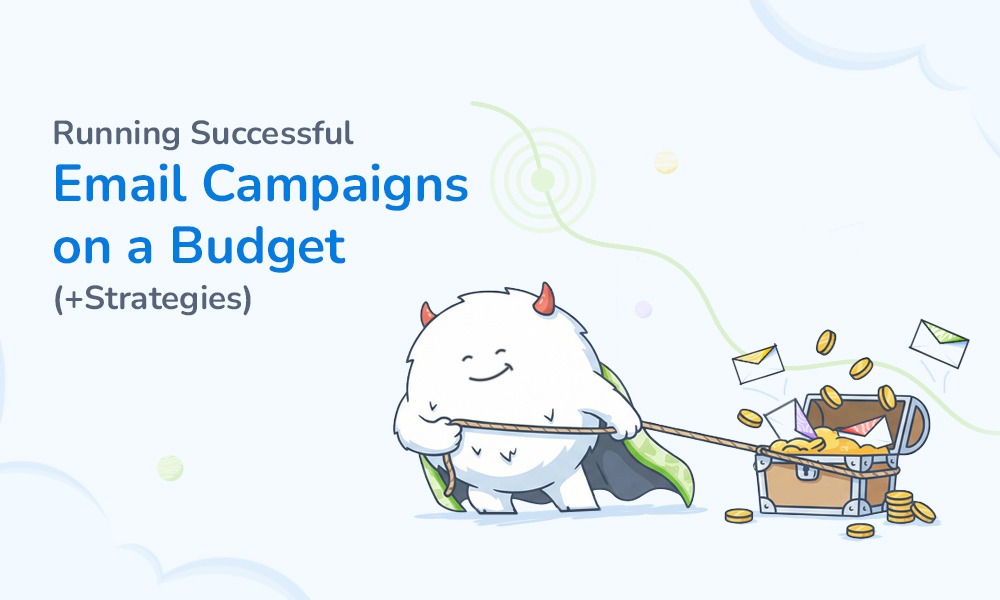
Executing successful email marketing campaigns on a budget means working smarter with what you have. After all, email marketing remains one of the most reliable and fruitful tools available to marketers. It’s a cost-efficient, direct, and fully controllable channel. When executed properly, your message lands exactly where it should—straight in your audience’s inbox.
Successful email marketing campaigns leverage affordable tools that deliver automation, personalization, and analytics at a low cost. It also means using smart tactics such as segmentation, personalization, and automation.
No matter your business, you can build conversion-ready and cost-effective email campaigns with the right tools and techniques that’ll help you squeeze the most value out of every email you send. Let’s see how.
Table of contents
- Foundations before you hit “Send”
- Cost-effective strategies for better results
- 3 best tools to get you started
- Ready to do more with less?
Foundations before you hit “Send”
If you approach email marketing as just another channel, you’re wasting time and resources. Before thinking about budgets or tools, make sure your foundations are solid. Without them, you’ll never know where your costs or results are leaking.
Define clear goals and KPIs
Every successful email marketing strategy starts with clear goals and email marketing KPIs. You need to know exactly what each campaign is supposed to accomplish and how to measure the outcomes. Without that, you’re just sending messages and hoping for results.
Define your main objectives early. Are you driving product sales, nurturing leads, promoting content, or building brand engagement? Each goal demands a different type of email and metric focus.
Once you’ve set your KPIs, align them with your broader marketing and revenue targets. This ensures your emails contribute to growth rather than just activity. Consistently track performance and benchmark against your past data. Of course, industry averages play an important part, but improvement over time is what matters.
When your goals and KPIs are clear, every send becomes intentional. You’ll know what’s working, where to optimize, and where to cut costs without hurting performance.
Create a segmentation strategy
When you’re keen to run successful email marketing campaigns on a budget, targeting becomes everything. Every email has to justify its cost. This means you need to send smarter messages to the right people. This is where segmentation comes into play. Segmentation ensures your emails reach the right people and have the highest impact, rather than being wasted on uninterested recipients.
Start with simple data. You don’t need to collect every piece of information that comes your way. Some key demographic and behavioral indicators will do the trick and make your messaging relevant. You just need the basics like location, purchase history, engagement level, and signup source. From that point on, you can personalize your offers, timing, and tone.
This kind of precision is what separates a profitable email strategy from a random batch-and-blast approach. And you don’t need the bells and whistles of a pricey tool to make it happen. Even the most affordable email marketing tools now include segmentation and automation features that make this process straightforward. Use them to group subscribers by intent, activity, or lifecycle stage, and focus your budget on the segments that actually convert.
In short, a lean campaign that aims to engage will outperform a large, unfiltered one. Segmentation ensures you’re spending where it counts and not paying to reach people who will never click.
Understand permission and deliverability basics
Deliverability isn’t just a technical concern but also a financial one. You can’t run cost-effective email campaigns if your messages never reach the inbox. Even the most well-planned successful email marketing campaigns fail if deliverability isn’t optimized. And every undelivered email represents wasted resources and lost conversions.
Let’s start with consent. When asking prospective subscribers permission to email them, always use double opt-in. This will confirm your intent and protect the quality of your list. Double opt-in also works as a built-in verification step and adds an extra layer of security by filtering out fake or mistyped addresses. This extra step could add friction, of course. However, it can also reduce spam complaints—only interested prospects will confirm their addresses, after all—and protect your sender reputation long term.
After that, maintain strict list hygiene. Regularly remove inactive subscribers, bounced addresses, and spam traps. A smaller, active list will always outperform a cluttered one. Additionally, most ESPs charge by contact volume, so cleaning your list directly lowers your costs.
Making it easy and visible to unsubscribe is another important step. It’s not a threat to your list but a safety valve that keeps your engagement metrics accurate and prevents frustrated users from marking your messages as spam.
Finally, authenticate your domain properly. Implement SPF, DKIM, and DMARC to verify that your emails are legitimate. This not only improves inbox placement but also protects your brand from spoofing and phishing attempts. Without authentication, even the best-crafted campaigns can end up in spam folders.
Create meaningful content
The quality of your email content directly determines the success of your email marketing campaign. When you’re operating on a budget, clarity and precision matter more than long-winded storytelling or intricate design. Each word, image, and layout choice should lead the reader further down the funnel and toward a measurable action.
The first thing to notice would be your subject line. Keep it clear, specific, and benefit-driven. Your goal should be to communicate value in as few words as possible. Avoid clickbaity copy or phrasing that might boost opens but lead to zero conversions. Consistency between your subject line and body copy builds credibility and strengthens your engagement rates.
Your email copy should also naturally guide readers toward a single primary call to action (CTA). Don’t overload with options. A single, focused message converts better and makes your results easier to analyze. Keep your paragraphs short, your tone direct, and your structure logical, with a headline, a value proposition (sometimes social proof as well, if the campaign calls for it), and an action.
Pro tip: Your content doesn’t exist in isolation. Make sure to create email content that can be repurposed across channels. For instance, you can schedule Facebook posts that echo your email campaigns to reinforce brand consistency without doubling your workload. When channels work in tandem, your audience receives a cohesive message that amplifies conversion potential.
Use clever email design
To accomplish successful email marketing campaigns, design your email templates with a mobile-first mindset. According to Statista, over 62% of traffic now happens through mobile users. This means a cluttered or unresponsive email layout can discourage more than half of your subscribers from clicking through and engaging further with your brand.
Test how your emails render across devices and email clients. Most affordable ESPs include responsive templates. However, customization often breaks layouts, so always preview before sending.
While we’re on the topic of visuals, balance is key. Images help reinforce branding and make your emails visually engaging, but they also increase load time and risk triggering spam filters. Follow a practical rule: Use images to support your message, not replace it.
Cost-effective strategies for better results
Creating smarter email campaigns that reach the right people at the right time means you’re making great use of your marketing budget. Let’s see the techniques to get you there.
Target recipients with the right content
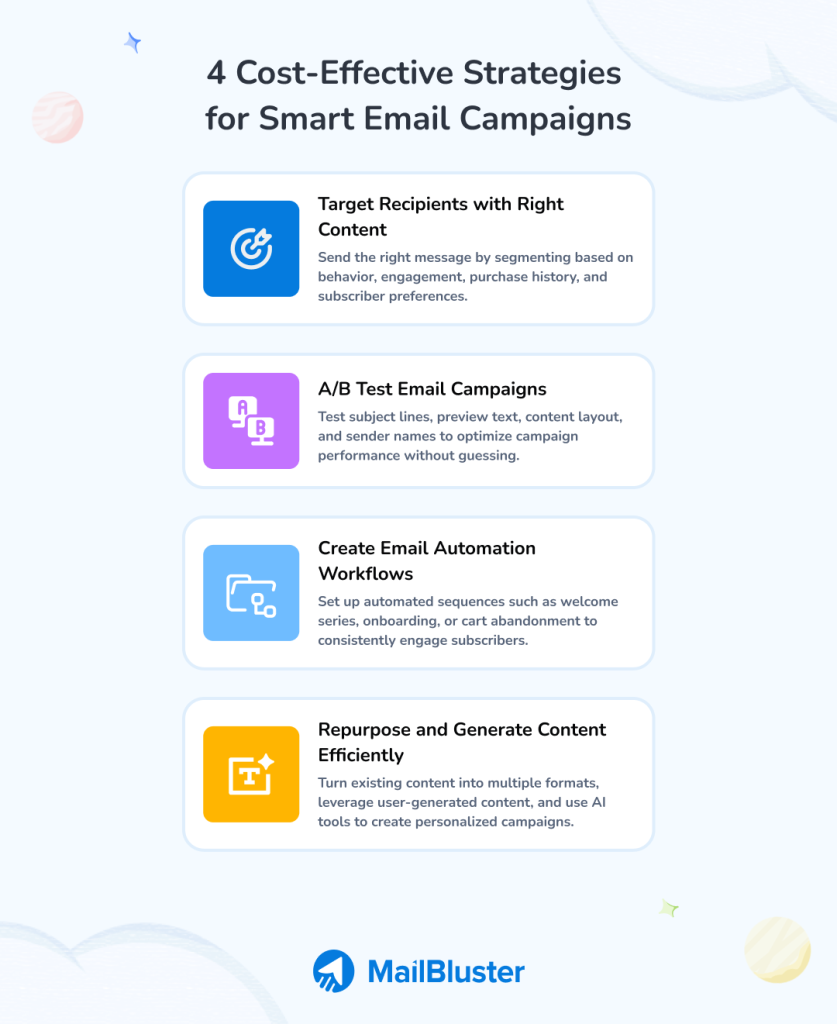
Nowadays, generic email blasts could be the fastest way to waste your time and blow through your marketing budget. Broad campaigns might reach more inboxes, but rarely move prospects with buying intent. Segmentation ensures your budget is spent on subscribers who are most likely to take action.
Start by segmenting based on behavioral signals (who opens, clicks, or converts). Engagement history is one of the strongest indicators of interest and intent. Sending re-engagement campaigns to inactive users while nurturing active users separately helps you maintain high conversion rates.
Add another layer with recency and purchase data. Someone who just bought from you needs different content than someone who hasn’t interacted in months. This doesn’t require complex systems. Most modern ESPs and affordable automation tools can easily handle basic behavior-based segmentation.
You can also let subscribers self-segment. A simple email preference center lets them choose which kinds of content they want to receive and how often they want to receive communications from you. This not only improves engagement but also reduces unsubscribes and spam complaints.
Over time, segmentation helps you identify which groups drive the most value. Focus your resources on those high-performing segments, and don’t be afraid to trim or pause communication with low-engagement ones. Every marketing action costs money; your job is to ensure your campaigns earn it back.
A/B test email campaigns
Working with guesstimates isn’t something you want to do when you’re on a budget, and every campaign counts. This is why you need to A/B test the components of your emails. A/B testing is an essential email marketing feature that lets you validate assumptions with data rather than intuition, helping you refine campaigns for maximum effectiveness.
Start by testing elements that directly influence engagement and conversion: subject lines, preview text, content layout, and sender names. Each of these can significantly affect open and click-through rates, but their impact varies depending on your audience.
For example, a personal sender name (“John from YourBrandName”) might outperform a generic one for a small-business audience, while a clean, branded sender name may build more trust in B2B.
Keep in mind that your tests should be focused. Only change one variable at a time so you can accurately attribute differences in performance. Testing multiple variables in one send may seem efficient, but it blurs results and wastes valuable sends.
Once you’ve gathered data, don’t jump to conclusions. It would be wise to run a second test and see if you can replicate the results as closely as possible. However, keep in mind that you should avoid over-testing.
Not every campaign needs an A/B test, especially smaller sends with a limited audience size. Without a good sample, you’ll never reach meaningful significance. Instead, test strategically and apply your learnings to future campaigns. Over time, these optimizations can lead to significant performance improvements.
Create email automation workflows
Automation is a key pillar of successful email marketing campaigns, turning engagement into steady revenue while reducing manual effort. Instead of sending one-off campaigns that require constant oversight, you can set up automated workflows strategically to build a self-sustaining system. This system can turn consistent engagement into steady revenue without extra overhead. With automated workflows, you can send emails that engage, convert, and retain subscribers, saving time and budget.
To make automation work for you, take advantage of core workflows:
- A welcome series. It introduces new subscribers to your brand, sets expectations, and drives initial engagement when interest is highest.
- An onboarding sequence. It helps new customers get value from your product or service faster, reducing churn and increasing satisfaction.
- A cart abandonment automation. It’s one of the highest-performing automations for recovering lost revenue with minimal effort.
These workflows nurture leads over time, ensuring that communication continues even when you’re not manually pressing “send.” They also provide valuable engagement signals you can feed back into your segmentation and optimization efforts.
But let’s move beyond workflows. Sending time optimization is just as important. Many email platforms can analyze past engagement data to send messages at the moment each subscriber is most likely to open them. This feature often boosts open and click-through rates without increasing your sending volume, making every email more cost-effective.
Repurpose and generate content efficiently
Creating great content doesn’t have to mean starting from scratch every time. The smartest email marketers know how to extract more value from what already exists, turning one asset into multiple pieces of content for touchpoints that span from your social media platforms to your YouTube channel’s trailer. This practice will reinforce your message across the funnel.
Start by repurposing your blog content. A strong blog post can easily become a multi-part email series, a newsletter feature, or a quick educational snippet for your audience. If you’re already publishing regularly, every article is an opportunity to reinforce authority and drive consistent traffic back to your site.
Incorporate user-generated content wherever possible. Reviews, testimonials, photos, or short quotes from satisfied customers will help you build credibility through social proof and save on content production costs. Authentic voices carry more trust than polished marketing copy.
Take advantage of dynamic content blocks in your emails. These allow you to show different sections of content to different segments based on location, behavior, or purchase history, all within the same send. It’s a simple way to personalize messaging without doubling your workload or campaign count.
When you need fresh material fast, use an AI writer as part of your workflow. Tools powered by AI can help you generate subject line variations, summarize long-form posts into concise email blurbs, or brainstorm copy for different audience segments.
Finally, personalize your content beyond just a first-name tag. Reference recent purchases, reading history, or stated preferences to make emails feel tailored and relevant. Even small adjustments in tone or product recommendations can significantly increase engagement.
By reusing and automating content intelligently, you lower production costs, maintain consistency, and deliver personalization at scale without adding complexity or draining your budget.
3 best tools to get you started
To implement the tactics and best practices mentioned above, you don’t need an expensive tool; you just need one that delivers on its promises. The right platform doesn’t just send emails; it enables successful email marketing campaigns through segmentation, automation, A/B testing, and deliverability control, while also providing advanced features like an AI writer and automated workflows — all without adding technical complexity or overhead.
Below are three practical options, including pricing, best-fit use cases, and a focused description of how each supports the tactics we discussed.
MailBluster
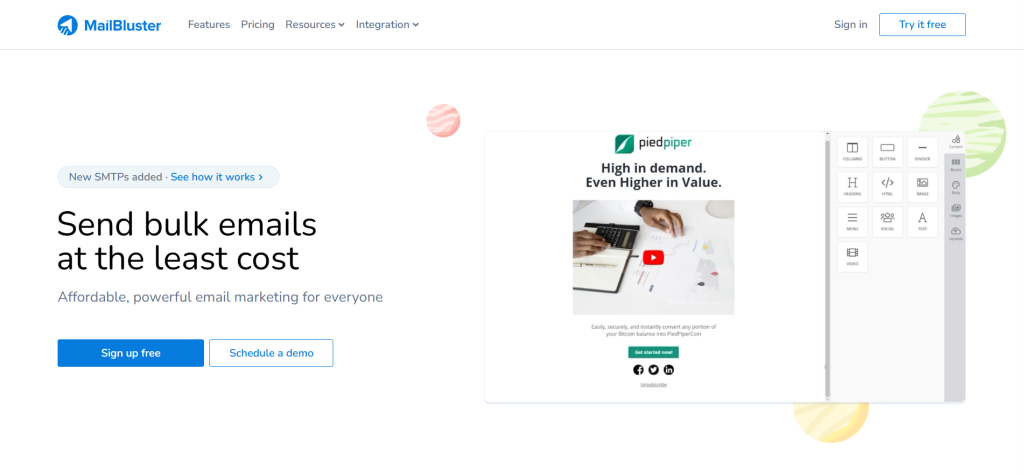
Pricing: Prices start at $60/year and include unlimited leads and emails. The platform offers a freemium plan that covers up to 3,000 emails.
Best For: Bootstrapped projects, creators, and small eCommerce stores.
MailBluster is an email tool that focuses on cost-efficiency without stripping essential features. It allows you to build email campaigns with a drag-and-drop editor and responsive templates. The tool also offers capabilities such as custom merge tags, list segmentation, and core analytics (e.g., opens, clicks, bounces).
MailBluster also supports double opt-in, list segmentation, A/B testing, autoresponders, and automation. Also, multi-SMTP providers and Managed SMTP have been implemented. The platform’s pricing model (low subscription fee and low per-1k-send rate) is useful when the list size or send volume fluctuates. You pay for volume without a big monthly commitment.
It also integrates with scalable SMTP providers like Amazon SES for cheaper delivery, offers time-warp/send-time controls, and provides basic reporting capabilities that help you iterate on subject lines and CTAs. Because the stack is intentionally minimal, MailBluster is great for teams who need deliverable, automated sends and segmentation at a very low cost. If you require basic analytics and minimal core features that get the job done, this tool would be a great fit.
Moosend
Pricing: 30-day trial available; paid plans start at $9/month (or $7/month, billed annually).
Best For: SMBs, eCommerce, entrepreneurs, and startups on a budget.
Moosend bundles the key features you need to run cost-effective programs without compromising quality. The platform’s visual workflow builder is intuitive and easy to use. It also offers automation recipes for essential automations like welcome, onboarding, and abandoned cart flows.
Moosend’s behavioral segmentation and custom fields capabilities can create targeted sends, while its built-in A/B testing tool works great for subject lines. Moosend’s easy-to-use no-code editor and extensive library with responsive templates can make your campaigns mobile-first by default.
The tool also focuses on deliverability and authentication, with support for SPF/DKIM/DMARC and bounce/spam tracking. All critical tools for maintaining a healthy inbox placement.
It also comes with robust reporting and analytics to feed your timing and significance decisions.
Finally, Moosend’s built-in AI writer can help with all content creation, from subject lines and copy to brainstorming sessions and copy checks. For a fraction of the cost of its competitors, you get automation, segmentation, and deliverability controls that let you implement the “send smarter, not more” approach with minimal additional tooling.
Constant Contact
Pricing: Prices start at $12/month; offers a free 14-day trial.
Best For: Small businesses, nonprofits, and event-based businesses.
Constant Contact emphasizes ease of use with its intuitive platform and no-code email editor. The platform provides prebuilt automation templates to help you get started (welcome, drip, event follow-up), as well as A/B testing capabilities on the more expensive tiers.
Constant Contact has segmentation and dynamic content options, as well as dedicated guides for SPF/DKIM/DMARC setup. Their platform also offers multi-channel capabilities, including social tools and SMS marketing, which is handy when you’re cross-promoting email with organic social posts and SMS notifications.
Deliverability monitoring and anti-abuse mechanisms are more prominent here. Constant Contact advertises industry-leading deliverability and has the infrastructure to protect sender reputation, reducing wasted sends and preserving ROI. Because it’s a more mature product, expect a slightly higher price for deliverability guardrails; for teams that can afford it, that reliability can be cheaper than the cost of lost conversions from poor inbox placement.
Ready to do more with less?
Running successful email marketing campaigns on a budget is about being intentional. When every send has a clear purpose, a defined audience, and a measurable outcome, even a small list can outperform larger, high-cost campaigns.
The strongest results come from strategy, not spending. Focus on segmentation, automation, and testing. These three levers will consistently raise engagement and revenue without inflating your costs. Lean, data-informed processes not only save you money but also keep your strategy scalable as your audience grows.
At the end of the day, email marketing rewards teams that treat it as a system, not a shot-in-the-dark approach. Use tools that align with your budget, iterate based on real performance data, and reinvest what you save into better creative, smarter workflows, and stronger relationships.
 Contents