











Looking for a reliable SendGrid alternative for sending marketing emails? SendGrid is a popular email tool, but it may have limitations that do not align with your marketing objectives. For example, they are more efficient at sending transactional emails than marketing ones. Email marketing is one of the most effective ways to engage audiences, boost conversions, and grow your business. Choosing the right email platform can save you time, improve deliverability, and optimize costs.
In this blog, we will explore SendGrid vs MailBluster by comparing features, pricing, and overall value, showing why MailBluster, as an alternative to SendGrid, can be the better choice for many businesses.
Table of Contents
- TL;DR Overview of SendGrid vs MailBluster
- Overview
- What is SendGrid?
- What is MailBluster?
- Why Choose MailBluster as a SendGrid Alternative
- Comparing user ratings according to G2 Crowd
- SendGrid vs MailBluster: Overall Feature & Facility Comparison
- Email Sending Pricing Comparison
- Comparison of Paid Pricing Calculation
- Verdict: Does MailBluster win as a SendGrid Alternative?
- Wrap Up
- FAQ on SendGrid Alternative
TL;DR Overview of SendGrid vs MailBluster
Time problem? Get an overview of the main differences between SendGrid and MailBluster.
| SendGrid | vs | MailBluster |
|---|---|---|
| Transactional email and SMS delivery | Best known for | Affordable and flexible pricing |
| Yes | Free pricing plan | Yes |
| Starts at $15/mo for up to 300K emails | Paid pricing plan | Starts at $0.6/1,000 emails monthly |
| Yes, for 60 days | Free trial | No, but the free plan works as a free trial |
| No | Money-back guarantee | Yes |
| Email and live chat | Customer support | Email and live chat |
| 4 | G2 rating | 4.7 |
Overview
Get introduced to SendGrid and MailBluster. It will help compare these two more effectively.
What is SendGrid?
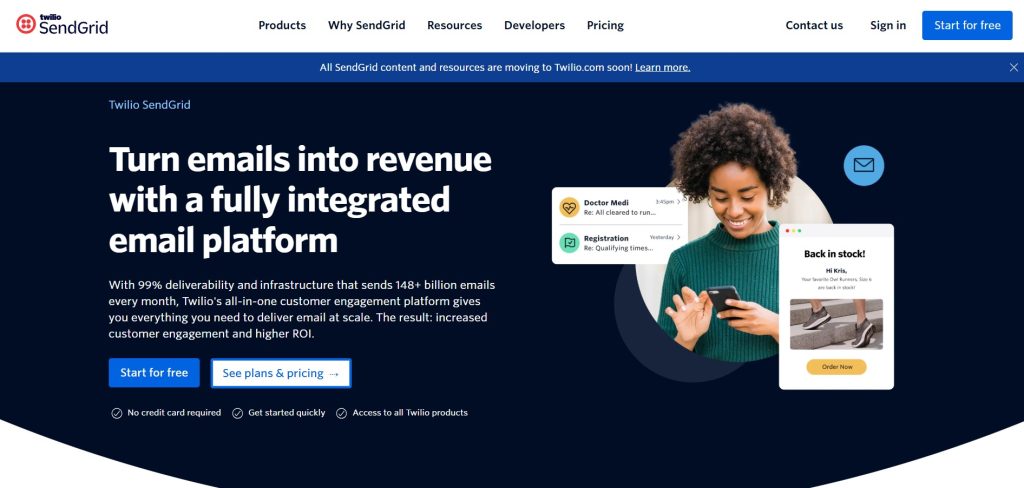
Twilio SendGrid, also known as Twilio SendGrid, is a cloud-based email delivery platform primarily used for sending transactional emails and large volumes of marketing emails via SMTP and APIs. Many developers and SaaS companies use it to ensure that account notifications, password resets, receipts, and large-scale email campaigns are delivered reliably. It focuses on deliverability and infrastructure rather than marketing-first simplicity.
What is SendGrid best for?
High-volume transactional emails, developers.
Overall key SendGrid features
- Email API & SMTP
- Transactional email sending
- Marketing campaigns & newsletters
- Automation workflows
- A/B testing
- Email templates
- Analytics & deliverability tools
- Email validation
- Signup forms
- Integration
SendGrid pricing
Keep in mind that SendGrid provides two different pricing plans for Email API and Marketing Campaigns. And here, as we are focusing on marketing email sending, so mentioning their pricing for Marketing Campaigns Plans.
- Free Trial: $0 for 100 emails and 100 contacts per day for 60 days.
- Basic: Starting at $15 for up to 300,000 emails and 100,000 contacts monthly.
- Advanced: Starting at $60 for 1,000,000 emails and 200,000 contacts monthly.
- Custom: Custom pricing plan for sending 2500,000+ emails.
SendGrid review
Rating: 4 out of 5 on G2
SendGrid pros
- Reliable email delivery infrastructure
- Strong support for transactional emails
- Powerful API and SMTP integration
- Scales well for high-volume sending
- Advanced analytics and automation options
SendGrid cons
- More technical and developer-focused
- Fixed monthly pricing can be expensive
- Less flexible for low or irregular sending
- Marketing features are not very beginner-friendly
What is MailBluster?
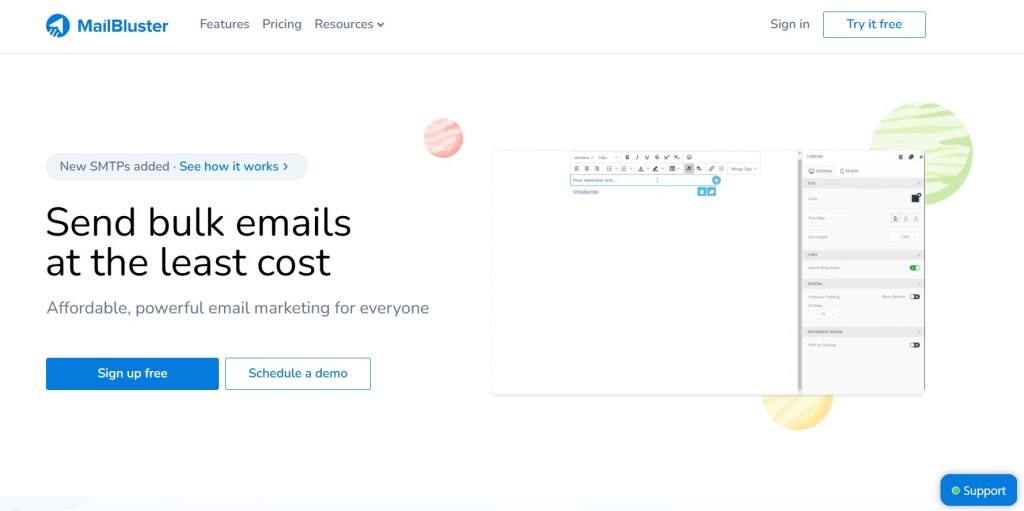
MailBluster is an email marketing platform that helps businesses, creators, and marketers send bulk emails, newsletters, and automated campaigns at a low cost. It focuses on simplicity and flexibility, offering pay-as-you-go pricing based on email sending volume rather than expensive fixed monthly plans, making it ideal for small businesses and growing teams that want an affordable alternative to traditional email marketing tools. And here, introducing MailBluster as a SendGrid alternative.
What is MailBluster best for?
Email marketing for startups and small businesses.
Key MailBluster features & facilities
- Unlimited bulk email sending
- Pay-as-you-go email pricing
- Email automation workflows
- Drag-and-drop email editor
- Premade email templates
- Multi SMTP providers
- Managed SMTP service
- Lead management
- List segmentation
- Double-opt-in
- Document API
- A/B testing
- Real-time analytics & reporting
- Forms
- Integrations
- Human customer support
MailBluster pricing
MailBluster pricing uses a pay-as-you-go (PAYG) system for its paid plan and a free plan that is easy to understand. It offers all the essential email marketing features, including advanced automation and responsive email templates. Also, it offers Managed SMTP to send emails effortlessly. Also, provides 24/7 human customer support. You can see how MailBluster can be a very affordable alternative to SendGrid by looking at the pricing information.
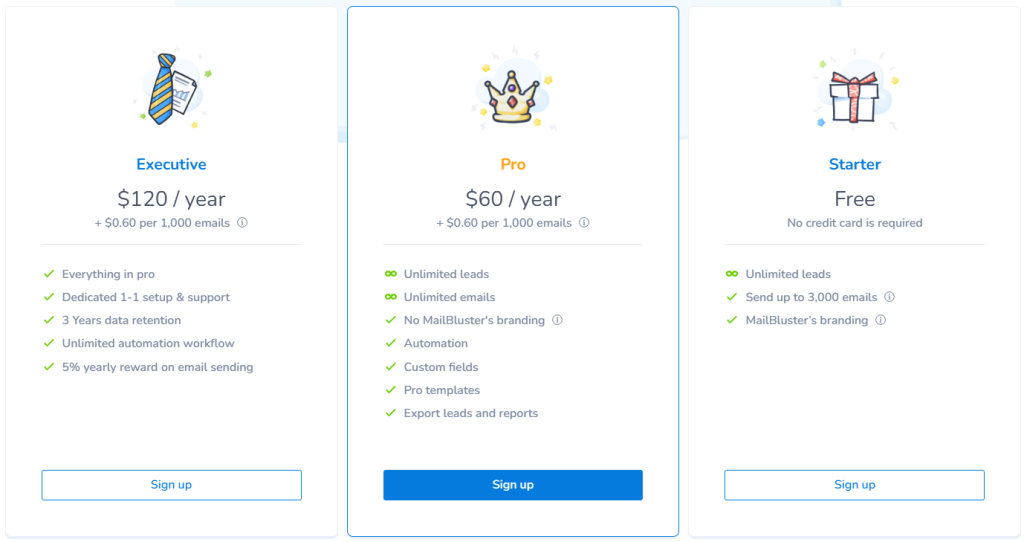
- Starter: $0 for 3,000 emails per account for one-time use.
- Best fit for testing purposes.
- Best fit for testing purposes.
- Pro: $0.60 per 1,000 emails per month and a $60 annual subscription fee.
- Best fit for email blast— sending unlimited bulk emails.
- Executive: $0.60 per 1000 emails per month and a $120 annual subscription fee.
Best fit for Businesses and corporate marketing.
MailBluster review
Rating: 4.7 out of 5 on G2
MailBluster pros
- Pay-as-you-go pricing based on email volume
- Managed SMTP and multiple SMTP providers
- Easy to use for marketers and non-technical users
- Built for newsletters and marketing campaigns
- Lower cost for small businesses and creators
- Simple automation and campaign setup
MailBluster cons
- No mobile app for email marketing
Why Choose MailBluster as a SendGrid Alternative
5 main reasons to choose MailBluster as a SendGrid alternative:
Flexible pay-as-you-go pricing
MailBluster charges $0.60 per 1,000 emails, so you pay only for what you send. This is especially well-suited for low-volume, seasonal, or variable email campaigns, offering better cost control than SendGrid’s flat monthly plans.
Simplified email marketing
With drag-and-drop editors, pre-built templates, and automation, MailBluster is designed for marketers and creators. Unlike SendGrid, you don’t need developer skills to run campaigns.
Ideal for newsletters and campaigns
MailBluster focuses on marketing emails, making it perfect for newsletters, promotions, and automated workflows, whereas SendGrid is often more developer-oriented.
Low entry barrier
Businesses can start small and scale gradually without paying large monthly fees, making MailBluster accessible for startups and small teams.
Cost-efficient at low volumes
For monthly email sends under 40,000 emails, MailBluster’s usage-based model is more economical than SendGrid’s flat pricing tiers.
Comparing user ratings according to G2 Crowd
According to the G2 star rating:
- SendGrid rating: 4
- MailBluster rating: 4.7
Now let’s review the email marketing campaigns of SendGrid vs MailBluster user ratings comparison from G2 Crowd (Jan, 2026):
| Rating category | SendGrid | MailBluster |
|---|---|---|
| Meets requirements | 8.5 | 9.5 |
| Ease of use | 8.2 | 9.2 |
| Ease of setup | 8 | 8.4 |
| Ease of admin | 8 | 9.4 |
| Quality of support | 7.5 | 9.2 |
| Has the product been a good partner in doing business? | 8.2 | 9.6 |
| Product direction (% positive) | 7.7 | 10.0 |
As you can see, MailBluster wins, scoring higher than SendGrid across all rating categories.
SendGrid vs MailBluster: Overall Feature & Facility Comparison
| SendGrid | Feature/facility | MailBluster |
|---|---|---|
| Yes | Marketing emails | Yes |
| Yes | Transactional emails | No |
| Yes | Email automation | Yes |
| Yes | List segmentation | Yes |
| Basic | Drag-and-drop editor | Yes |
| Yes | Premade templates | Yes |
| Yes | A/B testing | Yes |
| Yes | Email validation | No |
| No | Double opt-in | Yes |
| Yes | Forms | Yes |
| Yes | Integrations | Yes |
| Yes | Analytics and reports | Yes |
| Moderate: needs technical setup | Ease of use | Very beginner-friendly |
| No | Pay as you go | Yes |
| Chatbot, ticket, live chat & phone (only for paid plans) | Support | Human support via email and live chat |
Key Takeaways from the Feature Table
- MailBluster is simpler and more user-friendly for marketers and creators.
- Unlike MailBluster, SendGrid excels at transactional emails and advanced workflows rather than marketing ones, making it better for developers and large-scale app notifications.
- MailBluster’s usage-based pricing allows low-volume senders to save money, making it a cost-effective alternative to SendGrid.
- Both platforms provide essential tools for email campaigns, but MailBluster focuses on what small businesses and creators actually need.
Email Sending Pricing Comparison
SendGrid pricing for Marketing Campaigns has 4 plans, whereas MailBluster pricing has 3 simple plans. Compare SendGrid vs MailBluster pricing in the charts to see the details at a glance. See whether MailBluster is the best fit for you as a SendGrid alternative.
| Pricing plans | SendGrid | Pricing plans | MailBluster |
|---|---|---|---|
| Free Trial | $0 monthlyUp to 100 emails per day for 60 days | Starter | $0 for up to 3,000 emails (one-time use) |
| Basic | Starting at $15 for 300K emails per month | Pro | Unlimited emails starting from $0.60 per 1K emails monthly |
| Advanced | Starting at $60 for 1,000,000 emails per month | Executive | Unlimited emails, $0.60/1K emails, all Pro plan features & exclusive features |
| Custom | Custom for 2500K+ emails |
You can see that MailBluster’s pricing is usually easier to understand than SendGrid’s, which has several different expensive plans that can be hard for some users to understand.
Comparison of Paid Pricing Calculation
Now, we will calculate the email-sending costs for the lowest-priced plans of MailBluster and SendGrid and determine which platform is less expensive.
SendGrid’s lowest pricing plan for their Marketing Campaigns Plan is Basic, and it lets you send up to 300,000 emails a month at $200. And MailBluster will cost you $180 ($0.60 x 300,000/1000) for the same number of email sends.
Moreover, here’s the catch: Not only does MailBluster cost less than SendGrid, but with SendGrid, you can use very limited features. Unlike MailBluster, which allows you to have all the advanced email marketing features and facilities to send emails. If you want advanced features with SendGrid, you’ll need to use their higher tier. Which is way more expensive than MailBluster. So, if you can get all the advanced features and unlimited email sending facilities at the PAYG method, then why not go for the affordable one like MailBluster!
Verdict: Does MailBluster win as a SendGrid Alternative?
- Unlike SendGrid, with MailBluster, you only pay as per your email sends.
- You’ll get access to all the pro advanced features and facilities in exchange for an annual subscription fee of $60, which is equivalent to only $5 per month.
- If you have a small business or are running a startup with a tight budget, then you need what MailBluster offers.
- If your focus is not on sending transactional emails, then yes, MailBluster wins, especially for sending unlimited marketing emails at a very reasonable cost.
Wrap Up
We have reached the end of our discussion on comparing SendGrid vs MailBluster. Both SendGrid and MailBluster are popular email tools; choose whichever aligns best with your needs. For bulk marketing email sending, MailBluster is a highly efficient SendGrid alternative. This blog walks you through an in-depth comparison of these two renowned tools and shows how MailBluster is the best fit as a SendGrid alternative. MailBluster makes email marketing simpler, more flexible, and cheaper. Via the pay-as-you-go method, MailBluster charges only for emails sent. Especially for small to moderate email volumes, MailBluster offers more freedom and lower costs while still providing the features you need to grow your audience. Hence, the best SendGrid alternative is MailBluster, which saves money and grows with your campaigns. Now the choice is yours—sign up to join MailBluster if you think the same!
FAQ on SendGrid Alternative
Yes, MailBluster is a strong alternative to SendGrid for businesses focused on email marketing campaigns rather than transactional emails. It works well for newsletters, announcements, and promotional emails, especially when you prefer usage-based pricing instead of fixed monthly tiers.
No. MailBluster primarily uses a pay-per-email model, charging based on how many emails you send. In this comparison, only MailBluster’s email usage cost is considered, excluding subscription and SMTP delivery fees.
Small businesses with lower or inconsistent sending volumes may prefer MailBluster due to its usage-based pricing. Businesses with predictable or growing email volume may find SendGrid more cost-efficient in the long run.
MailBluster is better for people who aren’t tech-savvy and just want an easy way to send marketing emails without having to deal with APIs or tools made for developers. SendGrid might need more technical setup, especially for more complex use cases .
MailBluster provides 24/7 support via email and live chat.
 Contents
