











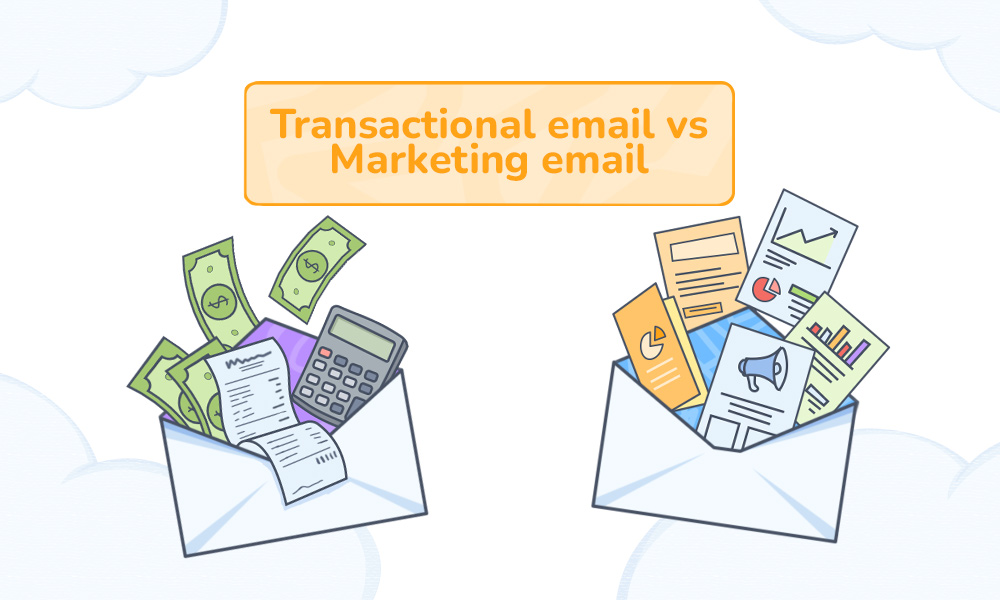
Transactional email vs marketing email is a common comparison for businesses trying to build better communication with their customers. While both are essential parts of email strategy, they serve very different purposes. Transactional emails focus on delivering important information triggered by user actions, whereas marketing emails promote products, nurture leads, and drive engagement.
Every email your business sends falls into one of two categories. Knowing which is which — and treating them differently — could be the most impactful thing you do for your email program this year. Understanding the difference between these two types of emails helps businesses improve customer experience, increase engagement, and stay compliant with email regulations.
In this blog, we’ll explore how transactional and marketing emails differ, their key use cases, examples, and when to use each. By the end of this discussion, all will be clear as day to you, so dive in.
Table of Contents
- Quick Takeaways on The Core Difference
- What is a Transactional Email?
- When Should You Use Transactional Emails?
- What is a Marketing Email?
- When Should You Use Marketing Emails?
- Transactional Email vs Marketing Email: Side by Side Key Differences
- Examples of Transactional Emails Types
- Transactional Email Examples
- Why You Must Keep Them Separate
- Send Both Transactional and Marketing Emails Efficiently
- Wrap Up
81% of businesses use email marketing as part of their marketing strategy — and it includes both transactional and marketing emails.
Quick Takeaways on The Core Difference
- Transactional emails are triggered by something the user did — a purchase, a signup, a password reset. The user took an action; the email is the system’s response. They expect it.
- Marketing emails are sent because your business decided to send them — a newsletter, a promotion, a nurture sequence. The user didn’t ask for it from the beginning; you need their consent to send marketing emails, especially due to GDPR compliance. That changes everything about how you write, design, and send them.
What is a Transactional Email?
A transactional email is an automated email sent to an individual user after they perform a specific action on a website or app. These emails deliver important information related to a transaction, account activity, or instant service update.
Unlike promotional marketing emails, transactional emails are not primarily designed for marketing. Instead, they provide information that the recipient expects and needs.
Common types of transactional email campaigns:
- Order confirmation emails
- Password reset emails
- Account verification emails
- Shipping notifications
- Payment receipts
- Security alerts
For example, when a customer purchases a product from an online store, they receive an order confirmation email immediately. This email reassures them that the purchase was successful and provides details about the order.
Transactional emails typically have very high open rates because users are actively expecting them.
When Should You Use Transactional Emails?
Transactional emails should be used whenever a customer needs confirmation or information about an action they performed.
Use transactional emails when:
- A customer completes a purchase
- A user signs up for an account
- Someone requests a password reset
- A payment is processed
- A shipment is sent
These emails improve customer trust and transparency because they keep users informed about important actions.
What is a Marketing Email?
A marketing email is designed to promote products, services, or content to a group of subscribers. These emails are part of a broader marketing strategy aimed at building relationships, increasing brand awareness, and driving sales.
Marketing emails are usually sent to a list of subscribers who have opted in to receive promotional messages.
Common types of marketing email campaigns include:
- Promotional offers and discounts
- Product launch announcements
- Newsletter updates
- Event invitations
- Seasonal campaigns
- Abandoned cart reminders
For example, a clothing brand might send an email announcing a “Summer Sale – 30% Off Everything.” The goal is to encourage recipients to visit the store and make a purchase.
Unlike transactional emails, marketing emails are typically scheduled campaigns sent to multiple recipients at once.
When Should You Use Marketing Emails?
Marketing emails should be used especially when your goal is to promote products, share updates, or build relationships with your subscribers.
Use marketing emails when:
- A business wants to announce a new product or feature
- A company is running a promotion, discount, or seasonal sale
- You want to send newsletters with blog posts, updates, or resources
- A brand wants to promote an upcoming event, webinar, or launch
- You want to re-engage inactive subscribers with special offers
- A business wants to nurture leads and guide them toward a purchase
These marketing emails help businesses increase brand awareness, engage subscribers, and drive conversions over time by delivering valuable content and promotions directly to their audience.
Transactional Email vs Marketing Email: Side by Side Key Differences
Transactional email vs marketing email: Understanding how these two email types differ can help businesses use them effectively.
| Feature | Transactional email | Marketing email |
|---|---|---|
| Purpose | Deliver important information | Promote products or services |
| Trigger | Sent after a user action | Sent as part of a campaign |
| Audience | One individual user | A list of subscribers |
| Content | Order details, account updates | Promotions, newsletters, offers |
| Send timing | Immediate and automated | Scheduled or campaign-based |
| Compliance | Often exempt from opt-in rules | Requires subscriber consent |
Examples of Transactional Emails Types
Because users expect them, transactional emails get opened at rates that marketing emails rarely touch. A well-designed order confirmation email isn’t just functional — it’s a brand touchpoint at peak attention.
A transactional email isn’t interrupting someone’s day. It’s completing a loop they started.
Common types:
- Order confirmations & receipts — Set expectations, reduce anxiety, and confirm the purchase immediately.
- Shipping & delivery notifications — Customers check these obsessively. Tracking links and delay alerts build trust.
- Password reset & security emails — Must arrive within seconds. A delayed reset results in a lost customer.
- Welcome & onboarding emails — Guide new users to their first “aha” moment while engagement is highest.
- Billing & renewal alerts — Prevent surprise charges and the churn that follows.
Transactional Email Examples
Transactional emails are triggered by user actions and provide essential information related to an account or transaction.
Sample 1: Order confirmation email
Subject: Your Order Has Been Confirmed
Hi Sarah,
Thank you for your purchase! Your order has been successfully placed and is now being processed.
Order Details
Order Number: #45821
Date of order: March 10, 2026
Total Amount: $89.99
You’ll receive another email once your order has been shipped.
If you have any questions, feel free to contact our support team [with link].
Thanks for shopping with us!
Best regards,
The Store Team
Sample 2: Password reset email
Subject: Reset Your Password
Hi John,
We received a request to reset your account password.
Click the button or link below to create a new password.
CTA: [Reset Password]
[Link] This link will expire in 30 minutes for security reasons.
If you did not request a password reset, you can safely ignore this email.
Best regards,
X Security Team
Examples of Marketing Emails
Marketing emails are how your brand speaks when nobody asked it to. Done right, they build brand equity, nurture leads, and generate revenue. Done wrong, they pollute inboxes and erode trust.
Unlike transactional emails, marketing emails require explicit consent in most of the world. Meaning you need to send marketing emails only to your organic email lists. The legal landscape is complex, and the penalties for getting it wrong are steep.
Common types:
- Newsletters — Regular content that delivers genuine value. The best ones are actually worth reading.
- Promotional campaigns — Sales, discounts, limited-time offers. Use strategically to avoid training customers to wait for deals.
- Drip & nurture sequences — Automated series that guide prospects at their own pace. Relevance is everything.
- Re-engagement campaigns — A well-crafted “we miss you” email can reactivate up to 15% of lapsed contacts.
- Event & webinar invites — Promotional intent paired with genuine value.
Marketing Email Examples
Marketing emails are designed to promote products, share updates, and encourage engagement.
Sample 1: Promotional offer email
Subject: 30% Off Today Only — Don’t Miss Out!
Hi Emma,
We’re celebrating our seasonal sale, and you’re invited!
For today only, enjoy 30% off everything in our store.
Use code: SAVE30
Shop now and grab your favorite items before the sale ends.
Shop the Sale
Happy shopping!
Best,
The Marketing Team
Sample 2: Newsletter email
Subject: This Week’s Marketing Tips + New Resources
Hi Alex,
Welcome to this week’s newsletter!
Here’s what we’ve prepared for you:
-A new guide on improving email open rates
-Marketing automation tips for small businesses
-Our latest blog on email campaign strategiesRead the full articles and discover new ways to grow your business.
CTA: Read the Blog
Thanks for being part of our community!
Best regards,
The Content Team
Why You Must Keep Them Separate
The most common mistake is sending both types from the same infrastructure. Here’s why that’s dangerous:
Deliverability contamination. Marketing campaigns generate spam complaints. If both email types share an IP and domain, those complaints tank your reputation — and your order confirmations start landing in spam.
Unsubscribe conflicts. If a customer unsubscribes from your list and your system isn’t segmented, they might also stop receiving transactional emails. Missing a password reset email is a legal and UX disaster.
The inbox is a trusted environment. Transactional emails built that trust. Marketing emails spend it, so spend wisely.
Send Both Transactional and Marketing Emails Efficiently
Managing transactional and marketing emails separately can become complicated and expensive, especially as your subscriber list grows. Businesses need a reliable email platform that can handle high-volume sending while keeping costs under control.
This is where MailBluster comes in.
MailBluster is a powerful email marketing platform built for startups, SaaS companies, and growing businesses that want to send large volumes of emails without paying high monthly fees. It’s more efficient in sending marketing emails. However, you can also send some trigger-based transactional ones, like abandoned cart and other transactional automated emails. Regarding billing and invoices, you can send them manually for now.
With MailBluster, you can:
- Send high-volume marketing campaigns with advanced email segmentation
- Build automated email workflows to engage subscribers
- Craft emails using the drag-and-drop editor or premade email templates by customizing to your needs
- Grow an organic email list for sending marketing emails using forms and the double-opt-in process
- Manage large email lists without expensive pricing tiers
- Track opens, clicks, and campaign performance in real time
- Deliver emails reliably using multiple SMTP providers
Unlike many traditional email platforms that charge based on subscriber count, MailBluster keeps pricing affordable, making it an excellent option for startups and small businesses.
Start sending smarter emails today with MailBluster and scale your email marketing without breaking your budget.
Wrap Up
That was all about comparing transactional email vs marketing email. Most marketers treat email as a single channel. One strategy, one team, one set of rules. But lumping transactional and marketing emails together is like using the same recipe for bread and birthday cake. Both involve flour, but the end results should be wildly different. Transactional emails are the promises you keep. Marketing emails are the conversations you start. Both matter, both require investment, and both perform dramatically better when you stop treating them as the same thing and utilize them wisely using an effective email marketing platform, like MailBluster.
FAQ on Transactional Email vs Marketing Email
A transactional email is an automated message sent to a user after they perform an action such as placing an order, signing up, or resetting a password.
A marketing email is a promotional message sent to subscribers to promote products, share updates, or build customer relationships.
Transactional emails usually have higher open rates because recipients expect them, and they contain important information related to their actions.
Yes, but the primary purpose must remain informational. Small promotional elements, such as product recommendations, may be included without changing the email’s classification.
 Contents
