










Looking for Mailchimp alternatives? Well, you are not the only one if you are considering switching from Mailchimp because of the fees that are increasing, pricing that is based on contacts, or restricted automation on lower tiers.
In this blog, I will compare the best 10 Mailchimp alternatives in 2026, providing details with honest pricing, true G2 ratings, and explicit pros and cons for each platform. Whether you’re a startup on a tight budget or an established ecommerce firm looking to expand, you’ll find the appropriate fit here.
NB: All included information is based on Feb, 2026
Table of Contents
- TL;DR: Mailchimp Alternatives Overview
- Why are people switching from Mailchimp?
- 10 Best Mailchimp Alternatives
- Wrap Up
- FAQ on Mailchimp Alternatives
TL;DR: Mailchimp Alternatives Overview
Don’t have much time to read? Then let’s take a quick Mailchimp alternatives overview!
| 10 Mailchimp alternatives | Best known for | Free pricing plan | Free trial | Paid plans | G2 review |
|---|---|---|---|---|---|
| MailBluster | Startups and small businesses | Yes | No | Starting with $.6 for unlimited emails monthly | 4.7 |
| Brevo | Small businesses and E-commerce stores | Yes | No | Starts from $9/mo | 4.5 |
| MailerLite | Simplicity | No | yes | Starts at $10/mo | 4.6 |
| ActiveCampaign | Advanced automation | No | Yes | Starts with $15/mo | 4.5 |
| Klaviyo | E-commerce brands | No | Yes | Starts with $20/mo | 4.6 |
| Moosend | Best budget automation tool | No | Yes | Starts at $9/mo | 4.7 |
| Omnisend | Omni-channel retail | No | No | Starting from $19/mo | 4.6 |
| GetResponse | All-in-one marketing suite | No | No | Starting from $19/mo | 4.3 |
| Constant Contact | Simplicity and support | No | Yes | Starts at $12/mo | 4.1 |
| HubSpot | All-in-one CRM + Marketing Hub | Yes | Yes | Starting from $20/mo | 4.4 |
Why are people switching from Mailchimp?
The most common reasons for Mailchimp migration include:
- Pricing model: Mailchimp charges for duplicate, unsubscribed, and inactive contacts, which can inflate costs significantly as a list grows.
- Transactional emails: Mailchimp doesn’t include a free add-on for transactional emails, unlike many competitors.
- Complexity: Users often complain that the interface is getting more and more crowded with features that aren’t email, like scheduling posts for social media and building websites.
10 Best Mailchimp Alternatives
Let’s compare and learn about the 10 best Mailchimp alternatives.
MailBluster
- Best for startups and small businesses
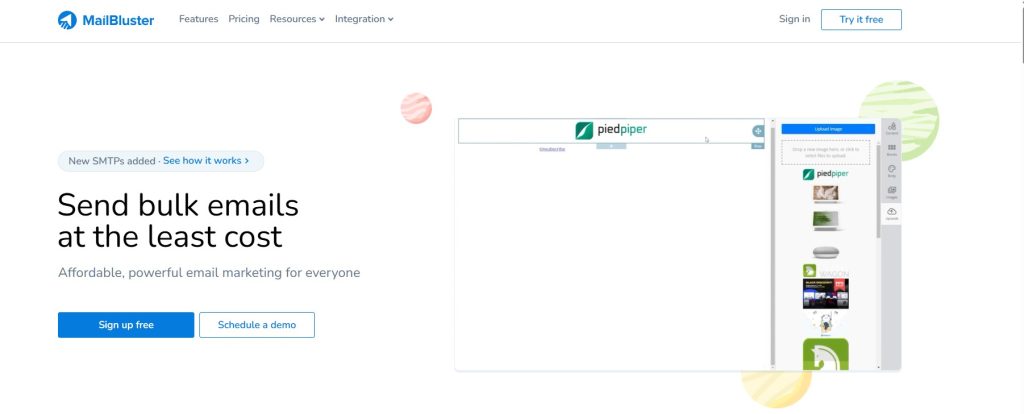
MailBluster is a cost-effective email marketing platform designed for businesses that want powerful campaign tools without expensive per-contact pricing. It offers a clean drag-and-drop builder, list segmentation, automation workflows, analytics, and high deliverability. The platform is especially attractive to startups and growing businesses sending high volumes of emails. It focuses on simplicity, transparency, and performance. Plus, MailBluster’s flexible pay-as-you-go pricing model lets you save real big!
Learn: Switching from Mailchimp to MailBluster and save big!
Key MailBluster features
- Email automation
- Responsive email templates
- Drag-and-drop email builder
- List segmentation
- Subscription inline forms and popups
- Usage-based high-volume sending
- Real-time analytics and reports
MailBluster pricing
- Starter Plan: Free 3000 emails (one-time) includes unlimited leads. Plus, it includes MailBluster branding.
- Pro Plan: $60/year (equivalent to $5/month) + $0.60 per 1,000 emails sent.
MailBluster G2 Rating: 4.7/5
Pros
- Extremely affordable compared to Mailchimp
- Pay-as-you-go style pricing (not contact-heavy billing)
- Drag-and-drop email editor
- Segmentation and automation included
- Strong deliverability setup
Cons
- Fewer advanced enterprise automation workflows
- Reporting is simpler than high-end platforms
- UI is more functional than flashy
When to Choose MailBluster
Choose MailBluster if you send large volumes of emails and want to reduce costs by 30–50% without sacrificing essential marketing features.
Brevo
- Best for small businesses and e-commerce stores
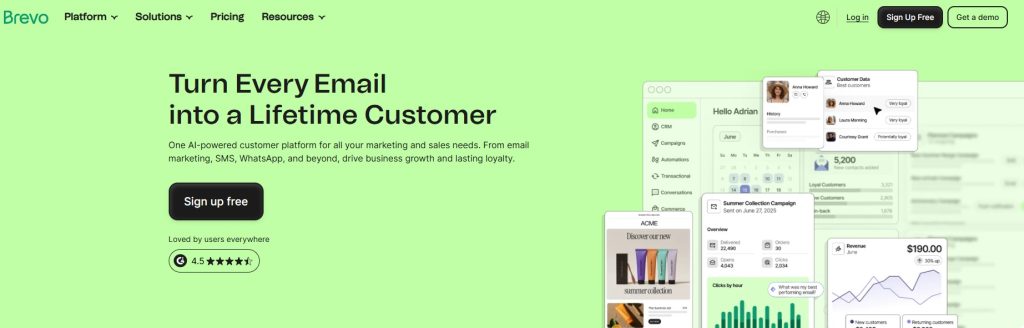
Brevo (formerly Sendinblue) is a multichannel marketing platform offering email, SMS, WhatsApp, CRM, automation, and transactional messaging in a single dashboard. Unlike Mailchimp, Brevo offers unlimited contacts on most plans and focuses on workflow automation across multiple channels.
Key Brevo features
- Email and SMS marketing
- Marketing automation workflows
- Built-in CRM
- Landing pages & forms
- Transactional email support
- Contact segmentation
Brevo pricing
- Free Plan: limited to 2000 contacts, 300 emails/day.
- Starter: From $9/month for 5,000 emails, and limited to 2000 contacts.
- Standard: From $18/month for 5,000 emails (includes landing pages, multi-user access). Includes unlimited contacts.
- Professional: From $499/month for 150,000 emails. Allows unlimited contacts.
- Enterprise: Custom pricing.
Plus, pay-per-send pricing model (charges by emails sent, not contacts stored).
Brevo G2 Rating: 4.5/5
Pros
- Unlimited contacts pricing
- Built-in CRM
- Strong automation builder
- Email and SMS in one tool
Cons
- Daily sending limits on the free plan
- Email templates feel basic
- Advanced features require higher tiers
When to Choose Brevo
Best for businesses seeking email, SMS, and CRM in a single ecosystem.
MailerLite
- Best for simplicity
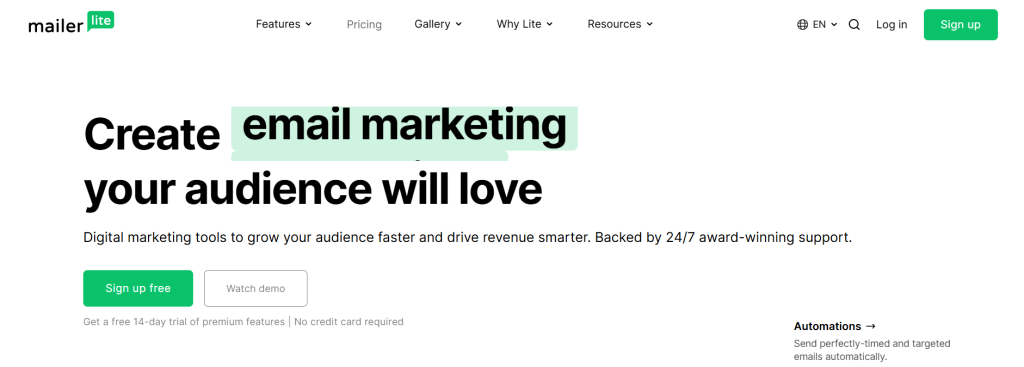
MailerLite is a beginner-friendly email marketing platform focused on clean design, ease of use, and affordable pricing. It includes automation, landing pages, signup forms, and email templates without overwhelming users.
Key MailerLite features
- Drag-and-drop editor
- Automation builder
- Landing pages & websites
- Popups & embedded forms
- A/B testing
- Subscriber segmentation
MailerLite pricing
- Free Plan: For up to 500 subscribers, 12,000 emails/month
- Growing Business: From $10/month (for up to 500 subscribers, unlimited emails)
- Advanced: From $20/month (for up to 500 subscribers, unlimited emails)
MailerLite G2 Rating: 4.6/5
Pros
- Intuitive interface
- Affordable pricing
- Automation on lower plans
- Good landing page builder
Cons
- Limited integrations compared to bigger platforms
- The account approval process can be strict
- Not ideal for complex enterprise needs
When to Choose MailerLite
Perfect for bloggers, creators, and small businesses wanting ease of use.
ActiveCampaign
- Best for advanced automation
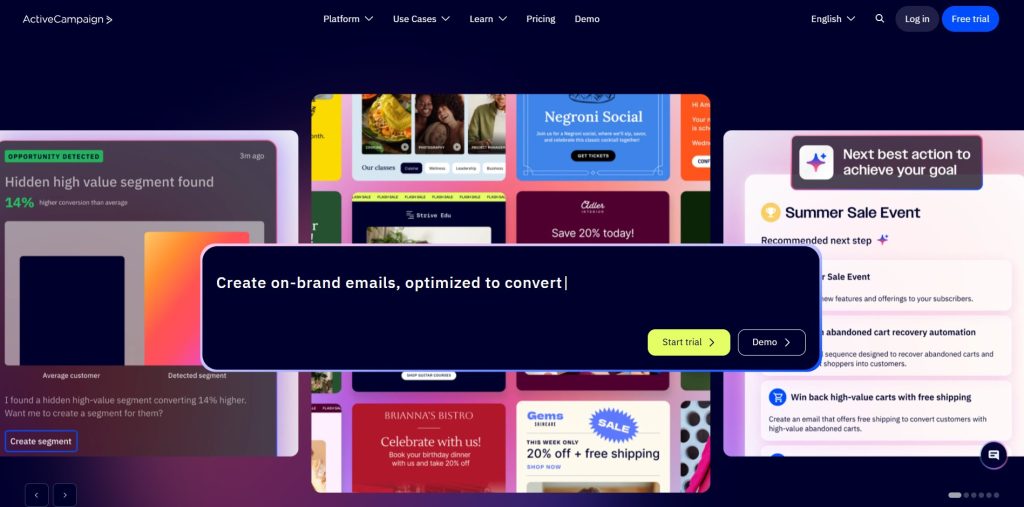
ActiveCampaign combines email marketing with advanced marketing automation, sales CRM, and lead scoring. It’s known for powerful visual workflows and behavioral automation.
Key ActiveCampaign features
- Advanced visual automation
- Built-in CRM & lead scoring
- Behavior-based triggers
- Email personalization
- Sales pipeline management
- Predictive sending & analytics
ActiveCampaign pricing
- Starter: From $15/month for 1,000 contacts, 10x email sends.
- Plus: From $49/month for 1,000 contacts, 10x email sends.
- Pro: From $79/month for 1,000 contacts, 12x email sends.
- Enterprise: From $145/month for 1,000 contacts, 15x email sends.
ActiveCampaign G2 Rating: 4.5/5
Pros
- Industry-leading automation
- Built-in CRM and sales tools
- Deep segmentation
Cons
- Higher pricing
- Learning curve
- Can feel overwhelming for beginners
When to Choose ActiveCampaign
Best for scaling businesses that rely heavily on automation and sales pipelines.
Klaviyo
- Best for e-commerce brands
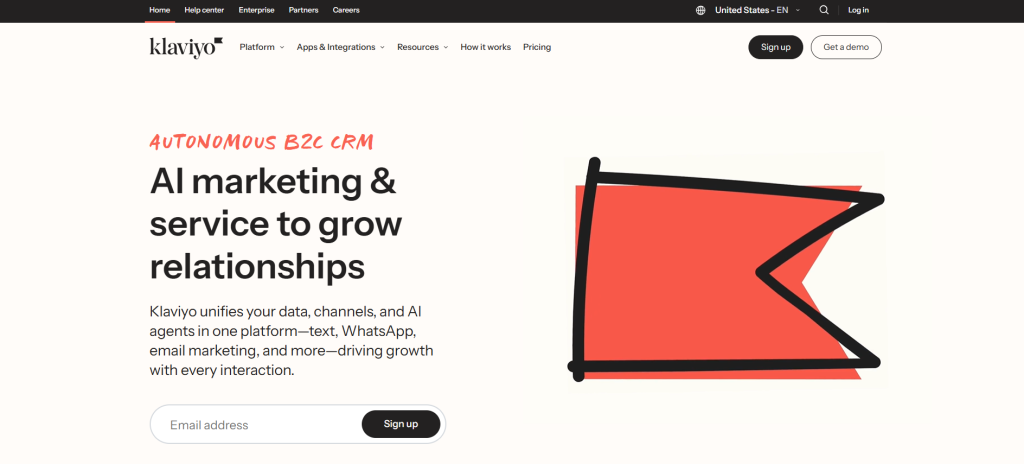
The email and SMS marketing tool Klaviyo is built especially for ecommerce brands and is based on data. It works very well with Shopify and WooCommerce and puts a lot of emphasis on tracking sales and segmenting consumers into groups.
Key Klaviyo features
- Ecommerce automation flows
- Revenue attribution tracking
- Predictive segmentation
- SMS marketing
- Deep Shopify/WooCommerce integration
- Advanced personalization
Klaviyo pricing
- Free Plan: Up to 250 contacts, 500 emails/month.
- Email plan for their Marketing section: From $20/month for 251-500 contacts, and 5,000 emails.
Klaviyo G2 Rating: 4.6/5
Pros
- Powerful ecommerce integrations
- Revenue attribution tracking
- Advanced personalization
Cons
- Expensive as the list grows
- Not ideal for non-ecommerce use
- Complex for beginners
When to Choose Klaviyo
Choose Klaviyo if you run an online store and want revenue-focused email automation.
Moosend
- Best budget automation tool
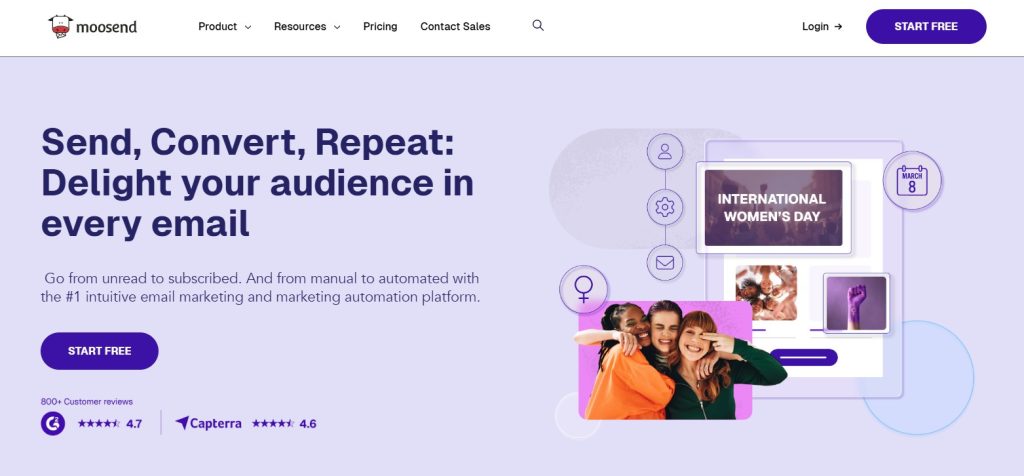
Moosend helps businesses of all sizes handle their email campaigns, mailing lists, and professional newsletters. It is a cloud-based email marketing and automation tool. It has been part of the Sitecore family since 2021.
Key Moosend features
- Automation workflows
- AI product recommendations
- Landing pages
- List segmentation
- Unlimited emails (paid plans)
- Real-time analytics
Moosend pricing
- Pro: From $9/month for 500 contacts and unlimited emails.
- Moosend+: Custom pricing: plan building based on your needs.
- Enterprise: Custom pricing: all advanced features in one plan.
Moosend G2 Rating: 4.7/5
Pros
- Budget-friendly
- Automation included
- Free trial 30 days with core features
- Unlimited emails on paid plans
Cons
- UI less polished
- Fewer integrations
- Smaller ecosystem
When to Choose Moosend
Ideal for businesses wanting automation without enterprise pricing.
Omnisend
- Best for omni-channel retail
Omnisend is a marketing automation tool for e-commerce businesses. Its main goal is to increase sales through integrated email, SMS, and web push alerts. It’s made for online stores that use platforms such as Shopify and WooCommerce. It comes with advanced segmentation, drag-and-drop editing, and pre-built automation workflows for things like abandoned carts.
Key Omnisend features
- Email, SMS, and push notifications
- Pre-built ecommerce workflows
- Abandoned cart automation
- Product recommendation blocks
- Audience segmentation
- Campaign performance tracking
Omnisend pricing
- Free Plan: 250 contacts and 500 emails/month.
- Standard: From $16/month for 500 contacts and unlimited emails.
- Pro: From $59/month for 2,500 contacts, and unlimited emails.
Omnisend G2 Rating: 4.6/5
Pros
- E-commerce-first features
- Multi-channel campaigns
- Easy Shopify integration
Cons
- Limited non-retail use cases
- Pricing increases with contacts
- Basic CRM features
When to Choose Omnisend
Great for retail and ecommerce brands needing cross-channel automation.
GetResponse
- Best for an all-in-one marketing suite
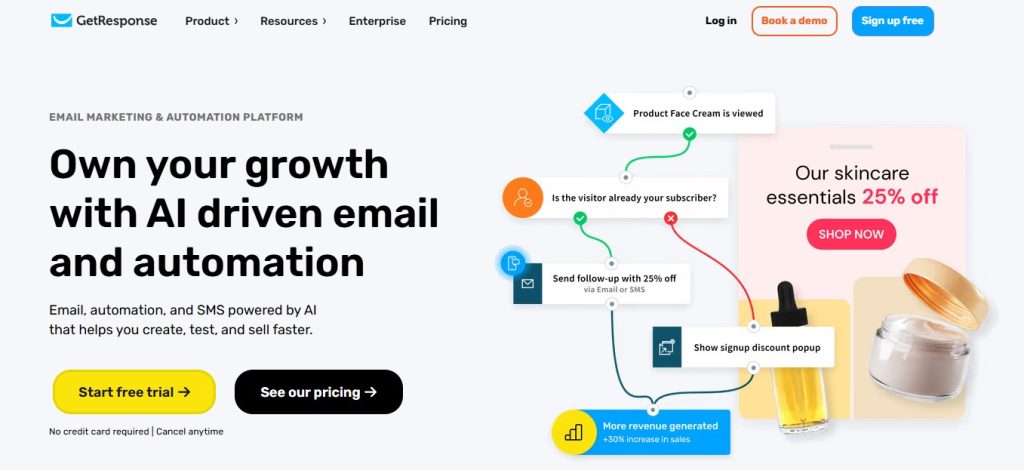
GetResponse is an AI-powered marketing tool that bundles email marketing, automation, and lead generation all in one. Offering tools such as landing pages, webinar hosting, and sales funnels to increase audience engagement and drive sales, it helps businesses build, manage, and improve their marketing campaigns.
Key GetResponse features
- Email marketing campaigns
- Marketing automation
- Webinar hosting
- Sales funnels
- Landing page builder
- Conversion tracking
GetResponse pricing
- Starter: From $19 for a 1,000 list size.
- Marketer: From $59/month for a 1,000 list size.
- Creator: From $69/month for a 1,000 list size.
GetResponse G2 Rating: 4.3/5
Pros
- Webinar hosting included
- Sales funnels and automation
- Good template library
Cons
- Can become expensive
- The interface may feel cluttered
- Some features are locked to higher tiers
When to Choose GetResponse
Choose if you want webinars, email, and funnels on one platform.
Constant Contact
- Best for simplicity and support
Constant Contact is a complete, easy-to-use digital marketing platform that helps small businesses make, handle, and keep track of social media, email marketing campaigns, and automated workflows. Drag-and-drop email templates, list management, SMS marketing, and numerous integrations help users close more deals.
Key Constant Contact features
- Easy email editor
- Event marketing tools
- Social media posting
- Contact list management
- Reporting dashboard
- Strong customer support
Constant Contact pricing:
- Lite: From $12/month for 500 contacts and unlimited emails.
- Standard: From $35/month for 500 contacts and unlimited emails.
- Premium: From $80/month for 500 contacts and unlimited emails.
Constant Contact G2 Rating: 4.1/5
Pros
- Beginner-friendly
- Strong customer support
- Event marketing tools
Cons
- Higher pricing
- Limited automation
- No permanent free plan
When to Choose Constant Contact
Ideal for local businesses and nonprofits that value support over advanced features.
HubSpot
- Best as an all-in-one CRM + Marketing Hub
HubSpot is a full CRM and marketing automation platform that includes email marketing as part of its Marketing Hub, seamlessly tied to sales, service, content, and reporting tools. It’s designed for businesses that want email plus deep customer insights, lifecycle tracking, automated nurture flows, and revenue attribution—all backed by a single centralized CRM.
Key HubSpot features
- Full CRM integration
- Advanced marketing automation
- Email marketing tools
- Sales pipeline tracking
- Lead scoring & lifecycle management
- Revenue attribution reporting
HubSpot Pricing (Marketing)
- Free Tier: $0 basic email tools & CRM, limited automation.
- Starter: $20/month, 1,000 marketing contacts, basic automation.
- Professional: $890/month, 2,000 contacts, advanced workflows.
- Enterprise: $3,600/month, 10,000 contacts & full enterprise features.
Note: HubSpot pricing scales with contacts and seats, can have onboarding fees, and costs more than most email-only tools.
HubSpot G2 Rating: 4.4/5
Pros
- Fully integrated CRM + email + automation + analytics suite.
- Best for multi-team collaboration in marketing, sales, and service.
- Strong lifecycle workflows and reporting tied to revenue.
Cons
- Much higher cost than most email platforms.
- Email marketing alone is more limited on the free tier.
- Learning curve for advanced features.
When to Choose HubSpot
Choose HubSpot if you want CRM, email, sales, and service tightly connected — especially for inbound-led growth, pipeline reporting, and cross-team collaboration.
Wrap Up
We are at the end of our discussion, and now you got to know all the best Mailchimp alternatives, each with key details. Try each Mailchimp alternative, especially those that allow a free trial or free plans. Just choose the one that aligns with your needs. For instance, if you want a super affordable and effective solution that will cover both your budget and key features, select MailBluster as your Mailchimp alternative without hesitation.
FAQ on Mailchimp Alternatives
For most businesses, MailBluster is the best overall alternative in 2026 due to its affordable pricing structure, high-volume capability, and simple workflow setup.
-Common reasons include:
-Rising pricing as subscriber lists grow
-Charging for unsubscribed contacts
-Advanced automation is locked behind higher tiers
-Limited customization compared to competitors
Many businesses look for usage-based pricing or better automation flexibility.
If you send high volumes of email, MailBluster is typically the most cost-effective because it uses usage-based billing rather than purely contact-based pricing.
For online stores:
-MailBluster, Moosend, Klaviyo — best for deep revenue tracking
-Omnisend — best for multi-channel retail automation
If ecommerce is your primary revenue source, choose a platform built specifically for storing data and customer segmentation.
Yes. Several platforms offer free tiers: MailBluster, Brevo, MailerLite, Omnisend, and Klaviyo. Free plans usually have send limits or branding restrictions.
For small businesses and startups: Budget + scalability → MailBluster, Simplicity → MailerLite, All-in-one CRM → Brevo, Strong support → Constant Contact.
For lists above 50,000+ subscribers: Cost efficiency → MailBluster, advanced segmentation → Klaviyo, CRM + automation → ActiveCampaign, transactional + marketing combo → Mailjet. High-volume senders should carefully compare pricing models (contact-based vs usage-based).
Most platforms provide CSV import tools, automation rebuilding tools, integrations with Shopify, WordPress, and CRMs, and onboarding customer support.
Migration typically takes a few hours to a few days, depending on complexity. With MailBluster, switching from Mailchimp takes 3-5 days and provides a smooth migration.
When it comes to price, scalability, and basic tools, MailBluster is the best in 2026. ActiveCampaign or Klaviyo might be better for you if you need more advanced business automation.
 Contents
