










Email marketing for authors is a reliable channel that can outperform other types of digital marketing. It’s an algorithm’s hassle-free, direct line of communication between authors and their readers.
65% of authors send email newsletters to share personal stories and updates. Surely, there are some strong reasons why such a large percentage of authors use email marketing. As an author, you need strong engagement with your readers and subscribers, which depends on your communication skills.
In this blog, I will discuss email marketing for authors in detail and share some of the best author newsletter ideas and strategies. Plus, you’ll get to see some of the best author newsletter examples from some of the bestselling authors, which will help you plan effectively.
Table of Contents
- What is Email Marketing for Authors?
- 11 Author Newsletter Ideas with Examples
- Welcome email for author newsletter subscribers
- Deals, news and updates newsletter
- Book cover reveal email
- Book promotion or new release email
- New book edition email
- Bonus chapter or content email
- Exclusive short stories, excerpts & deleted scenes email
- Sneak peek of upcoming projects email
- Book merchandise email
- Behind the scenes email
- ARC sign ups email
- Email Marketing Strategies for Authors
- Author newsletter content writing strategies
- Wrap Up
- FAQ on Email Marketing for Authors
What is Email Marketing for Authors?
Email marketing for authors is the process of using email to directly communicate with readers, build relationships, and promote books. It is an owned communication channel where authors can bypass third-party algorithms and reach their most dedicated fans.
Why Email Marketing for Authors is Essential?
For authors, sending author newsletters is essential for the following reasons:
| You own the audience | In contrast to social media, an email list is something you own and can control, so you can be sure that your email messages get to the right people without any problems. |
| Connecting directly and personally | It fosters a stronger, more personal connection with readers, allowing for tailored content that builds a loyal fan base and increases engagement. |
| Drives book sales effectively | Direct contact via emails with loyal fans makes it possible to promote new releases, book pre-order campaigns, and sales very effectively, resulting in a high return on investment (ROI). |
| Algorithm-proof marketing | There is no algorithm issue in email marketing. No matter what changes social media algorithms make, your message will always reach the right people through email. |
| Builds author brand | A big email list is an important part of a strong author brand or platform, and agents and publishers use it to decide whether to offer a book deal to an author. |
Email marketing is a stable, reliable, and powerful tool that helps authors connect directly and permanently with their readers, turning casual fans into strong supporters and buyers for life.
11 Author Newsletter Ideas with Examples
Let’s get some of the best author newsletter ideas, most of which you will find with examples! Yes, for you, I have run through my email inbox to fish out some of the best author newsletters from the bestselling authors so you can sharpen your ideas more efficiently.
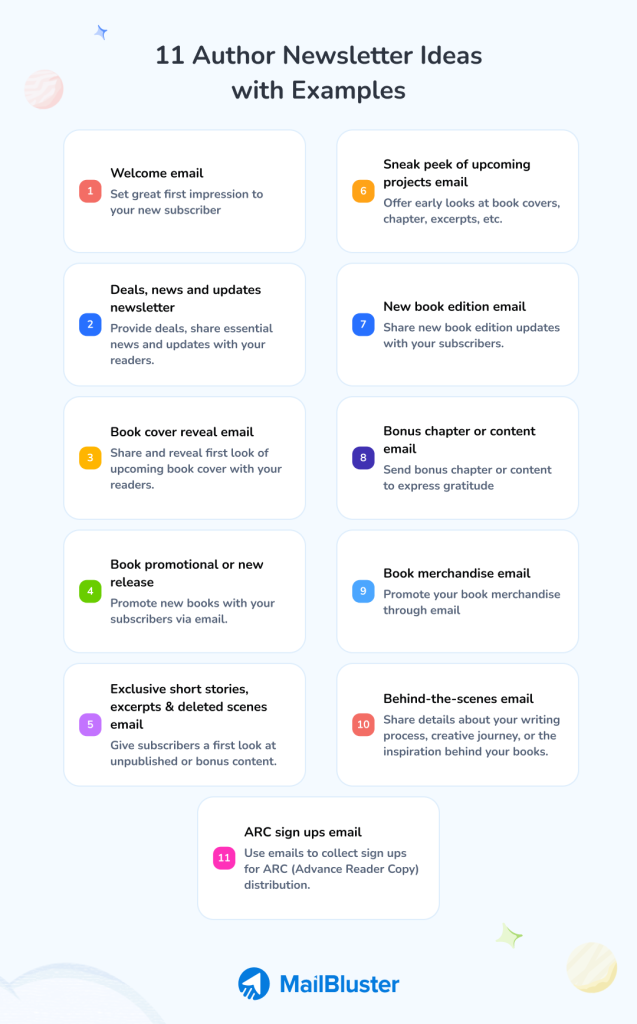
Before diving in, take a glimpse at the gist of this discussion.
Welcome email for author newsletter subscribers
In email marketing for authors, welcome emails are crucial for setting up an efficient first impression, and as an author, you have to include this in your author newsletter content ideas. See the given example and pick up ideas for your author welcome email content.
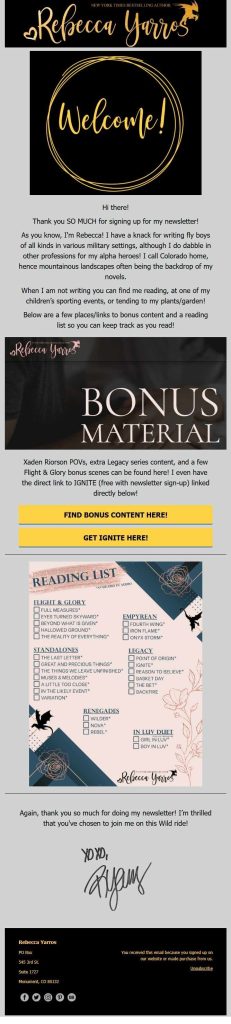
You must know about the highly popular book series The Empyrean or Fourth Wing by Rebecca Yarros. Well, this given author email example is from her, and I believe a popular author’s email can inspire you very much. Rebecca Yarros sent this welcome email to show gratitude for signing up for her newsletter. Apart from a good welcome message, it includes a bonus material, including Xaden Riorson POVs and some other bonus content. This free incentive will greatly make the subscriber feel valuable and worthy to sign up for your author newsletters. Take inspiration from this one to come up with your own.
Learn more: Welcome Email: Things To Know Before Sending
Deals, news and updates newsletter
Another author email content idea is for deals, news, and updates. Yes, provide deals and offers on different events, and also share essential news and updates. For instance, offer discounts on special events, such as sending Black Friday emails and holiday emails for these events. Also, if there’s any book award going on and you need votes for your books, then share it and urge them to vote for your book; don’t forget to include a suitable email CTA for it.
Book cover reveal email
If you are releasing a new book soon, then sharing the cover of the upcoming book with your readers and subscribers will effectively work as a teaser. And if the reader finds the cover attractive enough, then it will highly intrigue them to pre-order the book, especially the pretty book cover buyers. So, include the book cover reveal email in your author newsletter ideas and send it whenever you need to reveal the book cover for your new books.
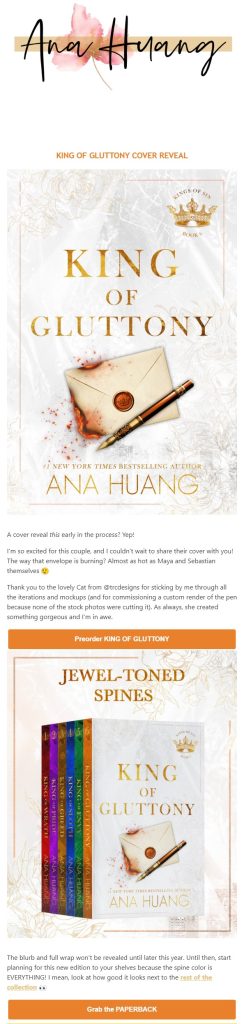
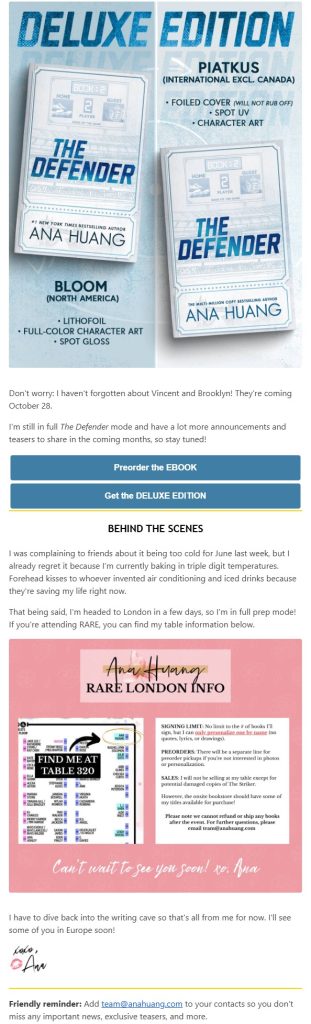
The given one is a book cover reveal email example. Ana Huang sent this email to her readers, including me, to reveal the cover of her upcoming book, King of Gluttony. Just notice how she did it; a high-quality image of the book cover and CTA for preordering is well placed. Plus, she added some other book edition updates at the end of the email. Surely, you can take inspiration from it to plan your own.
Book promotion or new release email
The next author email content idea is about the book promotional or new release email campaign. Whenever you release a new book, promote it through newsletters to your subscribers. You heard about the renowned books, Bride and The Love Hypothesis by Ali Hazelwood, right? Well, check out the given new release email example from this author.
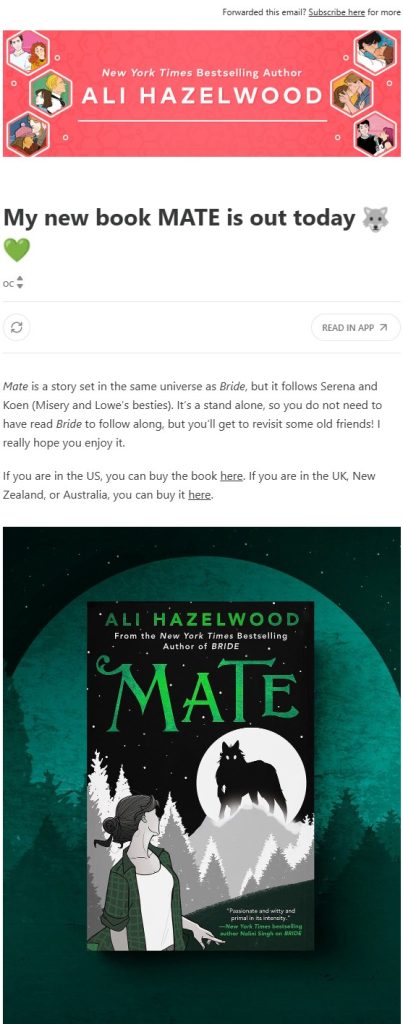

Mate by Ali Hazelwood is a new release book, so she sent this email to her newsletter subscribers to promote the new book with the heading “ My new book MATE is out today” with the book’s image in the email, along with other relevant stuff like merch, such as T-shirts designed with this book’s theme. Do take notes from it to make your own.
New book edition email
Whenever you are releasing a new edition of your already released book, do share it via email with your readers. For example, you will re-release one of your books with a different cover or some extra or revised words. And you need to inform your subscribers and readers about it so that anyone who’s interested can purchase.
Bonus chapter or content email
As a way to say “thank you” for signing up or to give extra value, you can send a bonus chapter or content via email to the subscriber. Bonus content can be any extra content of a book, such as an exclusive chapter, a guide, or a discount. This type of email is a marketing strategy to get people to interact with your author brand more, build a relationship with you, and be more likely to do something in the future, like buy your books. Remember the welcome newsletter example we came across earlier? That one has bonus content/material in it. If needed, you can take further ideas from that.
Exclusive short stories, excerpts & deleted scenes email
Send exclusive scenes, short stories, excerpts, and deleted scenes via email to your readers. This type of email content is very capable of increasing engagement with your subscribers. You can also include excerpts as a sneak peek; the next author newsletter idea will help you understand better.
Sneak peek of upcoming projects email
Present a glimpse of what’s about to come to your readers. Yes, give a sneak peek of your upcoming projects via email and add this idea to your author newsletter planner. Check out the following author email example from Ana Huang. She shared an excerpt from her book, The Defender, before its release.

Giving your reader a chance to sneak-peek into your upcoming projects, like a preview of a forthcoming book that you will release soon, can create a highly intriguing interest in your book. These types of email campaigns can be efficient in converting your subscribers into buyers.
Book merchandise email
A book merchandise email is an email related to the sale, promotion, or inquiry about merchandise associated with a book, author, or publisher, for instance, t-shirts, tote bags, bookmarks, mugs/cups, etc. Suppose you sell merchandise featuring your popular books and characters, such as t-shirts with the titles of your popular books or famous characters’ names and themes. Then you should also promote it through emails to readers and subscribers. Marketing your book merchandise with email is an effective way to reach your loyal readers.
Behind the scenes email
Making email content with behind-the-scenes of your book writing is another great idea for authors to engage with their readers. Pick stories behind your book-writing journey and share via email newsletters. How? Suppose you’re writing a book, then share your journey or any memorable moments behind book writing. This can highly boost engagement with your regular readers—especially the readers who have liked the said book.
ARC sign ups email
ARC is short for Advanced Reader Copy, which authors send to the readers in exchange for honest reviews. And you can use emails to collect ARC sign-ups for your upcoming book’s reviews. Simply put, “ARC sign-ups” refers to the emails where readers can learn about the ARC sign-up process, and eventually sign up through a relevant CTA to receive a free Advance Reader Copy of a book a few months before its official release date. In exchange for this early copy, the reader agrees to post a review after the book’s launch, helping the author generate buzz and credibility.
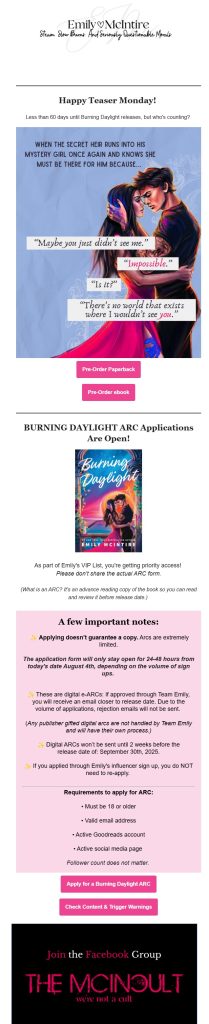
Take ideas from the given ARC sign up email example. Author Emily McIntire sent this one to her subscribers to gather ARC signups for her book Burning Daylights before its release. Book images, heading for ARC sign-up, and essential information regarding it all have been provided in an engaging way.
Email Marketing Strategies for Authors
To effectively connect with readers and sell books, authors need to implement an efficient email marketing strategy. Here are some key email marketing strategies for authors:
Choose the best email marketing service for authors
Select an email marketing service or platform that balances ease of use with powerful automation and segmentation features. Authors can find success with platforms like MailBluster, which often offer a free plan to help you get started, along with all the essential email marketing features.
Use newsletter sign-up landing page for organic list building
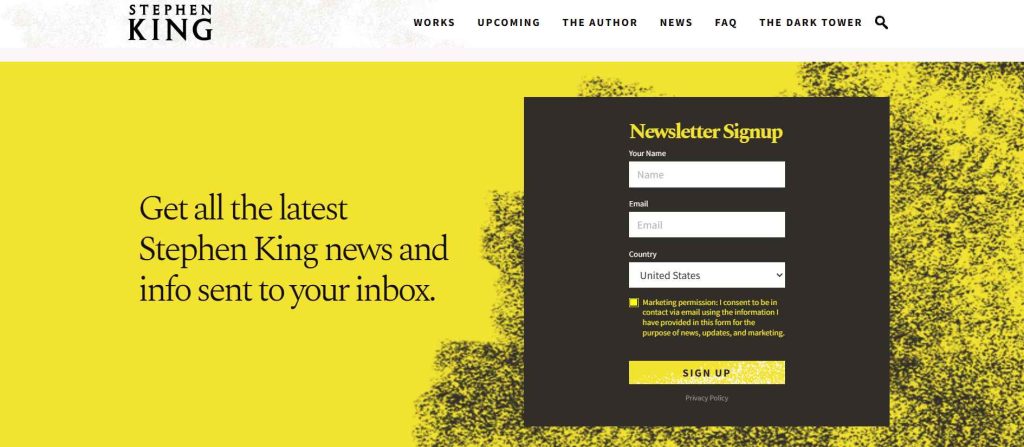
Set up newsletter sign up landing pages where people can sign up for your newsletter. See the following newsletter landing page of the popular author, Stephen King. This one is organized in an easy-to-follow manner and designed in a very catchy way.
Pro tips:
- Use a “reader magnet,” for example, a free short story, bonus chapter, excerpt, or novella, can be a great way to get people to opt in and join your email list. This works because you’re giving them something of value right away, which will intrigue them to join.
- Also, you can keep this landing page on your author website, share the link on your social media, and in the back of your books.
Segment email list and send personalized emails
73% of purchasers expect better personalization, so, as your list grows, divide your readers into segments based on things like their favorite genre, favorite series, past purchases, or where they live. This lets you send them targeted, personalized content that is more relevant to their interests, which will increase the number of opens and clicks.
Learn in detail: What is email segmentation?
Start by sending a welcome Email
The welcome email is exceptionally vital for starting your author newsletter campaigns. After someone subscribes to your reader email list, a welcome email needs to be sent right away.
Pro tip:
In your author welcome newsletter, introduce yourself, thank them for joining, give them their freebie, and let them know what kind of emails they can expect from you in the future and how often. This will immediately make a personal connection.
Send follow-up emails to both buyers and non-buyers
Send tailored follow up emails to both buyers and non-buyers of your book.
- For book buyers: Thank them for buying the book, ask for a review, provide a direct link to the review page as an email CTA, and suggest other books in the same or similar series.
- For non-buyers: As a gentle reminder, share an exclusive excerpt, a customer review, or a limited-time discount available only to them.
Pro tip:
Use the automation feature of your email marketing tool to send tailored follow-up email sequences.
Track key performance metrics
Monitor email campaign 4 key performance metrics regularly to refine your strategy:
- Open Rate: Indicates if your subject lines are compelling.
- Click-through rate, in short, CTR: Shows how engaging your content and CTAs are.
- Engagement rate: You will understand how you’re doing in engaging with your readers.
- Unsubscribe rate: Helps you gauge audience satisfaction and reduce unsubscribe rate.
Tracking these email performance metrics helps you to understand what resonates with your audience and improve future emails.
Learn: 9 Key Email Marketing KPIs to Track Your Campaign’s Success
Explore: MailBluster’s responsive email newsletter templates through which you can create email campaigns with your desired content ideas without any hassles.
Author newsletter content writing strategies
Let’s learn some essential strategies for writing the author newsletter content.
- Make the email write-up concise while ensuring it covers all essential email parts. Every email should be well-structured. Ensure you have:
- A captivating email subject line.
- A personal greeting.
- A clear, valuable message suitable for the context.
- A single or multiple, suitable and strong Call to Action (CTA).
- Check out: Email CTA examples & best practices
- A proper email signature.
- Add an unsubscribe link
- Why? It is essential due to regulations like CAN-SPAM and GDPR.
- Why? It is essential due to regulations like CAN-SPAM and GDPR.
- Craft visually appealing content: use suitable responsive email newsletter templates for your content and customize with a handy drag-and-drop feature —all these you’ll find in MailBluster, so check it out.
- Always include high-quality images and videos. And also make sure the images are eye-catching, especially the pictures of your books.
- Learn about: Email Images: Complete Guide to Using Images in Email
- Make your author emails mobile-optimized. Ensure emails are mobile friendly, as a big portion of people read emails on mobile devices.
Wrap Up
That was all for the discussion of email marketing for authors. This blog has shared all the essentials, including effective author newsletter ideas with various examples from the bestselling authors. All these will help thrive email marketing for any author who wants to succeed in email marketing. Implement the ideas and strategies suitably using a robust email marketing tool like MailBluster to keep up with your new and loyal readers.
FAQ on Email Marketing for Authors
Email marketing gives authors a reliable way to talk to their readers directly without having to go through the complicated rules of social media.
The “60/40 rule” says that the text-to-image ratio in emails should be at least 60% text and no more than 40% image. Also, make sure that the email body has at least 400 characters (60 to 100 words) of text that isn’t pictures.
Popular, author-friendly options offering free tiers that can be best include MailBluster, Mailchimp, and Kit. The right choice depends on specific needs and budget.
It’s essential to stay consistent. Most authors send an email once or twice a month, but it’s more important to stick to a regular schedule than to be exact about email frequency; how often you send emails.
Your welcome email should include a thank you, welcoming greetings, and offer the free incentive you promised. Also, make it clear what to expect from future emails, introduce yourself personally, and give them the option to reply if they want to.
Read more on email marketing:
B2C Email Marketing
B2B email marketing
Email Marketing for Photographers
Real estate email marketing
Jewelry email marketing
Black Friday email marketing
 Contents
